Custom Therapy Website vs. Templates: Which is Right for Your Practice?
Save time and money without sacrificing your brand. A guide to choosing the perfect digital foundation for your mental health practice.

.jpg)
Before changing your website, identify which of these two problems you have:
If your website receives little traffic, you may need to improve local SEO, create service pages, publish useful content, strengthen your Google Business Profile, or build more referral links.
If people are visiting but not inquiring, your website may have unclear messaging, missing information, weak calls to action, or too many obstacles between interest and contact.
Review your website analytics and inquiry history before assuming you need more marketing. Here is an article about an effective marketing strategies for therapists and counselors if you want to know more. Knowing which problem you have will help you invest your time and budget in the right solution.
Your website needs to answer four questions quickly:
If visitors have to search for those answers, they may leave even if you are qualified to help them. The following improvements focus on making those answers clear.
Your homepage should tell visitors who you help, what you help with, and where or how you provide therapy. This information should appear near the top of the page, ideally before a visitor needs to scroll.
A broad headline such as “Find healing and become your best self” may sound warm, but it does not help a visitor decide whether your practice fits their needs.
A clearer headline might say:
Compassionate anxiety therapy for adults in Austin, Texas, and online across the state.
This does not need to include every service you offer. It only needs to give the right visitors enough clarity to keep reading.
For a group practice, the message can reflect the wider range of support available:
Personalized therapy for adults, couples, and families in Portland, Oregon.
In one therapy website redesign, the original homepage opened with a beautiful nature image and the message, “Find the way back to yourself.” Although appropriate for therapy, the hero did not explain what the practice offered, who it served, where services were available, or how therapy could help. Useful details were spread across the page without a clear flow.
I reorganized the full website so each page had a clearer purpose and information hierarchy. The redesigned hero now identifies therapy in Wenatchee and across Washington for trauma, anxiety, and emotional healing, explains the intended benefit, and offers one clear action: schedule a consultation.
This was not simply a visual update. The new headline gives potential clients and search engines meaningful information immediately, while the supporting message and call to action make the next step easier to understand.
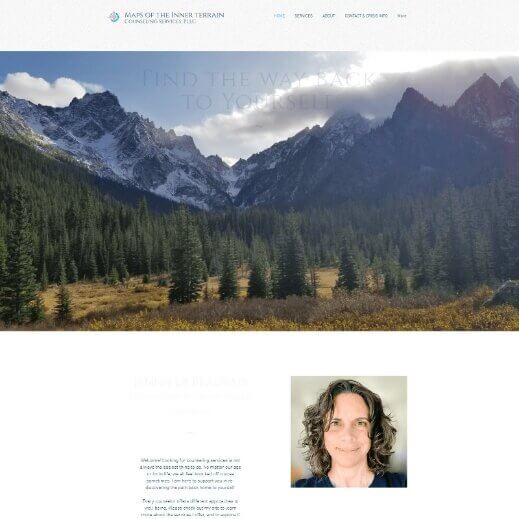
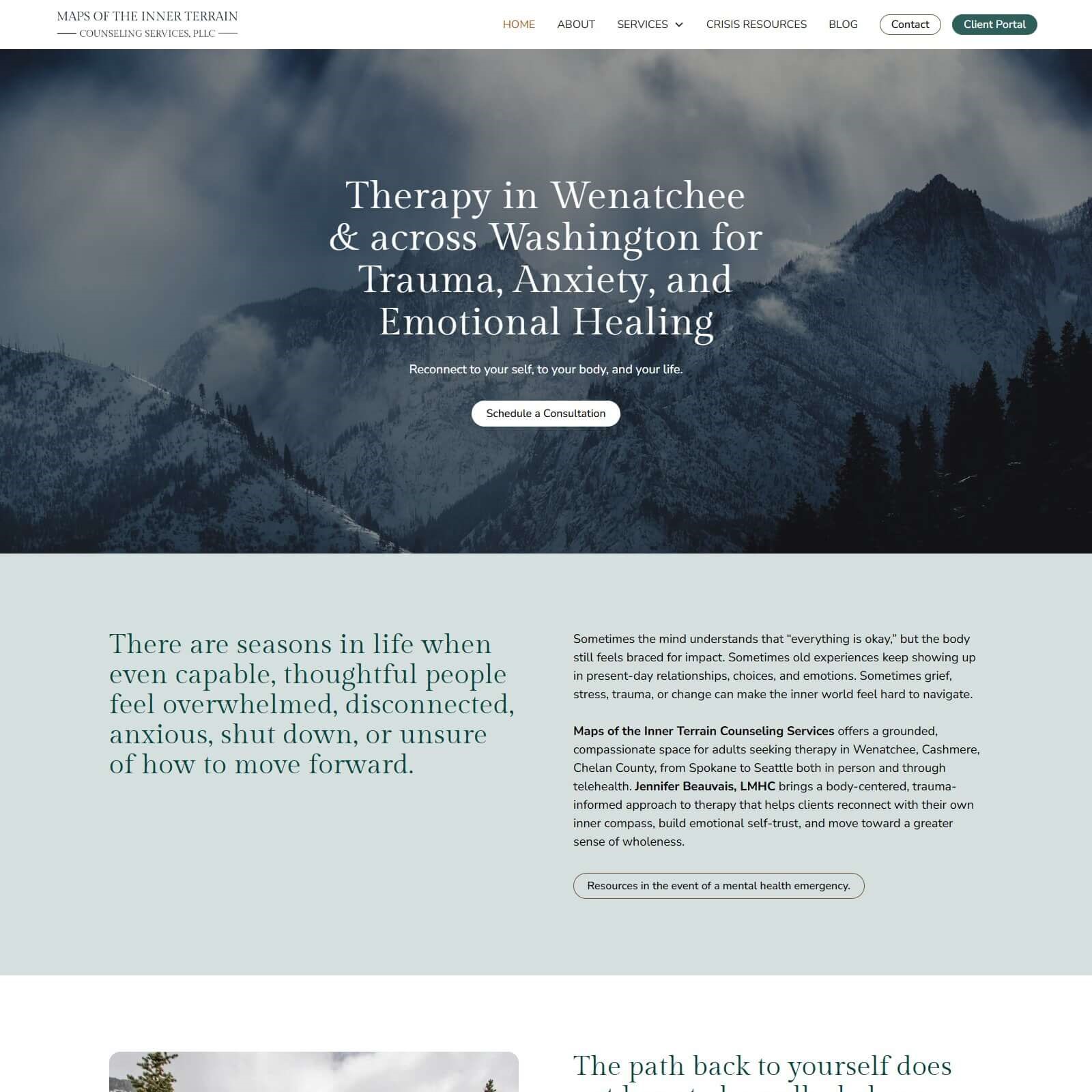
This comparison focuses on the top of the homepage because that is where visitors form their first impression and decide whether to continue.
Specific messaging helps ideal clients recognize themselves. It also helps search engines and AI tools understand what your practice offers and whom it serves.
Your education, credentials, modalities, and professional experience matter. However, a potential client usually arrives with a more immediate question: “Can this person help me with what I am going through?”
Start service pages by describing the visitor's experience in clear, compassionate language. Then explain how therapy may help and what working with you can look like.
Instead of leading with:
I use an integrative approach that incorporates CBT, ACT, and mindfulness.
Try:
You may understand why you feel anxious and still find yourself caught in the same cycle. Therapy can help you notice those patterns, respond differently, and feel more confident handling difficult moments.
You can introduce your modalities afterward and explain them without jargon. This keeps the copy client-centered while still demonstrating your expertise.
If anxiety therapy, couples counseling, trauma therapy, and life transitions are all summarized in a few sentences on one page, visitors may not find enough information to feel understood.
A dedicated page for each primary service allows you to answer concerns specific to that client. It also gives search engines a focused page to consider for searches such as “anxiety therapist in Denver” or “online couples therapy in California.”
A useful service page should explain who the service is for, the experiences it addresses, how therapy may help, your treatment approach, what sessions may look like, and how to take the next step.
Avoid creating many thin pages that repeat the same information. Prioritize the services most important to your practice and make each page genuinely useful.
A visitor should never have to wonder how to contact you.
Use one primary call to action consistently throughout the website, such as:
Place it in the navigation, near the top of important pages, and again after sections that help visitors make a decision.
Avoid changing the wording constantly. “Let's connect,” “Learn more,” “Begin your journey,” and “Get started” may all lead to the same form, but using several phrases can make the process feel less predictable.
Clear does not mean pushy. For someone considering therapy, knowing exactly what happens next can feel reassuring.
Every additional form field asks a potential client to give you more time, attention, and personal information. If your initial contact form feels like a full intake assessment, some visitors may postpone it or leave.
Ask only for what you need to respond appropriately, such as a name, contact details, preferred contact method, general reason for reaching out, and preferred therapist when applicable.
Tell visitors when they can expect a response and what will happen after they submit the form. For example:
We usually respond within one business day to discuss availability and help you determine the best next step.
Do not ask visitors to submit sensitive clinical details through a standard website form. Make sure your form and communication process suit the privacy requirements that apply to your practice.
Potential clients are not only evaluating your services. They are deciding whether contacting you feels emotionally and practically safe.
Trust-building elements can include a warm professional photograph, relevant credentials, a clear explanation of your approach, the populations you serve, fees or insurance information, office and telehealth details, frequently asked questions, and a simple explanation of the consultation process.
Testimonials can be ethically sensitive for therapists and may be restricted depending on your profession and location. You do not need them to build credibility. Clear information, thoughtful copy, consistent design, and an understandable process can establish trust without client endorsements.
More clinicians and services can make a group practice website more useful, but they can also create decision fatigue.
For example, someone may arrive after searching for trauma therapy and find twelve clinician biographies. If the website does not show which therapists work with trauma, offer the preferred appointment format, or accept new clients, that visitor may leave even though the practice has the right clinician.
Do not expect visitors to open every therapist biography and compare credentials on their own. Give them a simple way to narrow their options by concern, age group, availability, insurance, location, or therapy format.
Each clinician page should clearly explain who the therapist works with, the concerns they address, their approach and communication style, where and how they provide therapy, whether they accept new clients, and how to request an appointment.
If your practice matches clients manually, say so. A call to action such as “Let us help you find the right therapist” can feel much easier than asking someone to make the decision alone.
Unanswered questions create hesitation. A helpful FAQ section can remove practical uncertainty before a visitor contacts you.
Answer practical questions about fees, insurance, online therapy, licensure, session length, the first appointment, therapist matching, availability, populations served, and scheduling.
Use direct, concise answers. FAQs also give search engines and AI systems clearly structured information they can understand and surface in relevant results.
A website can look beautiful on a desktop and still be frustrating on a phone. Buttons may be hard to tap, paragraphs may feel too long, forms may not fit the screen, or images may take too long to load.
Review your website on several mobile screen sizes. Make sure a visitor can understand your offer, read comfortably, open the navigation, tap the primary call to action, complete the form, and find fees, location, and availability.
Compress oversized images, remove unnecessary animations, and avoid adding features that slow the page without helping the client make a decision.
Conversion improvements cannot help if the wrong people are visiting your website.
Effective SEO for therapists begins with relevance. Each important page should clearly communicate the service, ideal client, and geographic area it supports. Your page titles, headings, copy, image descriptions, internal links, and metadata should reinforce that focus naturally.
For local practices, keep your practice name, address, phone number, service area, and Google Business Profile information accurate and consistent. For online therapy, clearly state where you are licensed to serve clients.
Blog posts can answer questions potential clients ask before seeking therapy, but they should connect naturally to your services. A large number of unrelated visitors will not necessarily produce more inquiries. The goal is qualified traffic from people your practice is equipped to help.
In many cases, listing fees helps potential clients make an informed decision and makes the process more transparent. If fees vary, provide a range and explain relevant insurance, out-of-network, or sliding-scale options. If you do not publish an amount, tell visitors when fees will be discussed.
You do not need a page for every possible issue. Create separate pages for primary services with distinct needs or search intent, such as couples therapy and trauma therapy. Smaller, closely related concerns can be covered within broader service pages. Quality matters more than page count.
Use one primary call to action, such as “Schedule a Consultation,” consistently throughout the website. You can repeat it in the navigation, hero, service pages, and final sections. A secondary action may be useful for visitors who are not ready to inquire, but too many competing options can create hesitation.
Track qualified organic traffic, consultation requests, form completions, booking clicks, conversion rate, mobile engagement, common exit points, and which inquiries become clients. Review patterns over time. If visitors reach the contact page but rarely submit the form, the form or next-step messaging may need attention. If service pages receive almost no visits, visibility may be the larger problem.
Targeted updates may be enough if your website is technically sound, works well on mobile, and still reflects your practice. A redesign makes more sense when your practice has changed, the site is difficult to update, the design no longer feels credible, or it cannot support your services, clinicians, or locations.
A professionally designed template can provide a strategic structure and faster launch. Custom design is often better for more complex practices requiring therapist matching, several locations, specialized intake pathways, or a distinctive brand strategy. Choose the option that gives potential clients the clearest path from finding your practice to contacting you.
Getting more therapy clients is not only about attracting more visitors. It is also about helping the right visitors feel understood, informed, and confident enough to take the next step.
Start with clarity. Make it easy for people to understand who you help, how you help, and how to contact you. Then strengthen the experience with focused service pages, reassuring answers, thoughtful design, and a simple inquiry process.
If your current website no longer supports your practice, you do not have to start from a blank page. Explore AC Digital's professionally designed therapy website templates to see how a clear homepage, focused service pages, trust-building sections, and a simple inquiry path can work together. Each template provides a strategic foundation that can be adapted to your brand and services. If your practice needs therapist matching, multiple locations, specialized intake pathways, or a more distinctive structure, custom website design may be the better fit.
Explore Therapy Website Templates