How to Get More Therapy Clients From Your Website: 10 Conversion Fixes
If people are visiting but not inquiring, your website may have unclear messaging, missing information, weak calls to action, or too many obstacles...

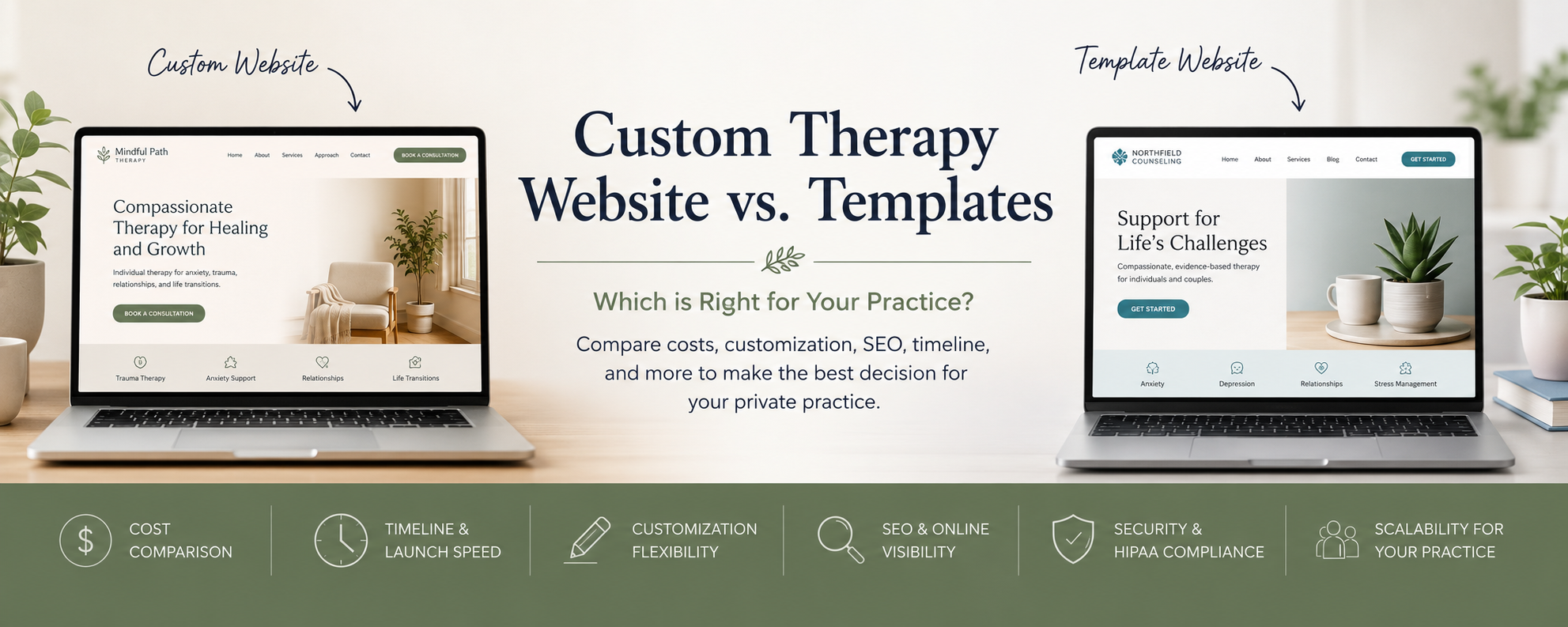
If you're planning a new website for your therapy practice, you've probably found yourself asking the same question many therapists do:
A custom website and a therapist website template can both create a professional online presence, but the right choice depends on your practice, budget, timeline, and functionality needs.
Your website is often the first impression a potential client has of your practice. It can influence whether they stay, explore your services, or quietly leave and continue searching for another therapist.
The good news is that choosing between a custom website and a template isn't about picking the "better" option. It's about choosing the option that's right for your practice today—and one that supports where you want your practice to be in the future.
Many therapists assume that custom websites are automatically more professional, more trustworthy, or better for search engines. Others worry that templates will look generic or limit their ability to grow.
The truth is more nuanced.
And not every template-based website is DIY. At AC Digital, I use a professionally designed website as the starting point, then handle the copy, branding, images, SEO, and customization for you. You get the speed and affordability of starting with a template without having to build the website yourself.
Over the years, we've seen beautifully designed custom websites that struggled to attract new clients because they were confusing to navigate. We've also seen thoughtfully built therapist templates that consistently generated inquiries because they focused on what actually matters: clarity, trust, and a smooth client experience.
Google doesn't reward websites simply because they're custom-built.
Potential clients don't choose a therapist because the website was designed from scratch.
They choose the therapist who makes them feel understood, safe, and confident enough to take the next step.
That's exactly what your website should help you do.
In this guide, we'll walk through the differences between custom websites and templates, when each option makes sense, common misconceptions, and the factors that truly influence your website's success. By the end, you'll have a clear understanding of which approach is the best investment for your practice—not just today, but for years to come.
The main difference is that a custom website is designed from scratch, while a template-based website starts with a professionally designed framework that is personalized for your practice.
Let’s look at each option more closely, because this is where many therapists get confused.
A custom website for therapists is built specifically for your practice from the ground up.
Everything—from the page layouts to the user experience—is planned and designed around your unique goals. Nothing exists until it's designed and developed.
A custom website gives you complete creative freedom.
You can create unique page layouts, advanced functionality, custom animations, specialized client portals, or workflows that don't exist in standard website solutions.
Because every detail is created from scratch, custom projects typically involve:
Discovery meetings
This process produces a completely bespoke website, but it also requires a larger investment of both time and budget.
A therapist website template is a professionally designed website framework that can be personalized with your branding, copy, services, photos, and practice information.
Instead of starting with a blank canvas, you're starting with a professionally designed website framework that's already been planned around the needs of therapists and private practices.
Think of it like moving into a beautifully designed home.
The structure already works.
A therapist website template gives you a professionally designed starting point instead of a blank canvas.
The structure and layout are already in place, then the website can be personalized with your brand colors, fonts, logo, photos, services, biography, practice information, and copy.
With my done-for-you service, you don't have to customize those things yourself.
You choose the design you love, and I'll personalize it for your practice.
The result is a website that feels like your own without the time and investment of designing every page from scratch.
The result feels uniquely yours without needing months of design work.
For many therapists, I believe this offers a practical balance of professional design, affordability, and speed.
A therapist website template gives you a pre-designed structure created for a therapy practice, while a DIY website builder leaves you responsible for deciding how the website should be organized and designed.
This distinction matters because a template and a DIY website builder aren’t the same thing.
Many people think "template" means using a drag-and-drop website builder and trying to figure everything out on their own.
They're not the same.
A generic counseling website builder gives you hundreds of layouts designed for every type of business imaginable—restaurants, gyms, photographers, online stores, consultants, and more.
You're responsible for figuring out:
For someone who has never built a website before, that's a lot to figure out.
A done-for-you, template-based website takes a different approach. You choose a professionally designed starting point, and I handle the copy, branding, images, SEO, and customization for you.
Instead of asking, “What should I put on my homepage?” or spending hours figuring out how to customize a template yourself, you can focus on your practice while I take care of the website.
The pages are intentionally organized to guide potential clients from curiosity to confidence.
Instead of asking, "What should I include in the navigation menu?" you're asking, "How can I make this reflect my practice?"
That shift saves an enormous amount of time and often leads to a better outcome.
No. A website template is only the starting framework, and your branding, photography, messaging, services, and content can make the finished website feel completely unique to your practice.
One of the most common concerns I hear is, “I don’t want my website to look like everyone else’s.”
It's a valid concern. But here's the reality:
A website template is only the starting point.
Once I personalize the colors, typography, photography, messaging, logo, and content around your practice, the finished website begins to feel like your own.
Think about buying a home from the same floor plan as your neighbor.
The structure might be similar, but once each family decorates, furnishes, paints, and personalizes the space, the homes feel completely different.
The same principle applies to websites. In fact, most visitors have no idea whether a website began as a template or was designed from scratch.
What they notice instead is:
Those are the details that influence whether someone reaches out.
Yes. A professionally designed therapist website template can create a polished, credible website without requiring every layout and design decision to be created from scratch.
Good design isn’t about reinventing every element of a website. It’s about solving problems effectively.
Some therapists worry that choosing a template somehow sends the message that they're cutting corners.
In reality, many successful businesses use professionally designed templates as the foundation for their websites.
Why? Because good design isn't about reinventing the wheel.
It's about solving problems effectively.
Over time, designers learn what works.
Clear navigation.
Thoughtful spacing.
Readable typography.
Simple calls to action.
Logical page flow.
These aren't limitations.
They're best practices.
Professional templates start with established design best practices instead of requiring every decision to be made from scratch.
The true cost of a website includes more than the initial price—it can also include your time, launch delays, revisions, and the opportunities you miss while waiting for the website to go live.
When people compare pricing, they usually look at one number: how much does the website cost?
But that's only part of the picture.
The bigger question is:
What does each option actually cost over time?
Imagine two therapists opening their practices at the same time.
Therapist A hires a custom agency.
Therapist B chooses a done-for-you website that starts with a professionally designed template.
Therapist A spends several months working through strategy sessions, revisions, and development before the website is ready.
Meanwhile, Therapist B launches within a few weeks or less and begins showing up in search results, networking, sharing resources, and collecting inquiries.
Launching sooner gives Therapist B more time to build visibility, share resources, connect with referral partners, and make the practice easier to find online.
Every month your website isn't live is another month of missed opportunities for potential clients to discover your practice.
Sometimes the biggest cost isn't the invoice. It's the time spent waiting.
A custom website usually requires more decisions, meetings, revisions, and mental energy because the design is being created from the ground up.
Building a custom website can mean making hundreds of decisions about layouts, navigation, images, colors, functionality, and content.
Should the navigation look like this?
Should this image move?
Should the button be green or blue?
Should this section move higher?
Should I redesign the homepage again?
While those decisions can produce something beautiful, they also consume time and mental energy.
As therapists, your expertise isn't choosing button styles or debating layouts.
It's helping people heal.
A done-for-you website removes many of those decisions from your plate. You start with a design you already love, and I handle the details of personalizing it for your practice.
Instead of spending weeks discussing every design decision, you can focus on your clients and your practice while I take care of the website.
A custom website makes the most sense when your practice needs advanced functionality, complex integrations, multiple locations, specialized workflows, or a digital experience that an existing framework can’t reasonably support.
Not every therapist needs a template, and there are situations where investing in a custom website is the appropriate choice.
A custom website may be worth the investment if your practice has needs that go far beyond a traditional marketing website.
For example, you might benefit from a custom solution if you:
In these situations, building from scratch provides the flexibility you need.
Custom development allows every feature, workflow, and interaction to be tailored specifically to your organization.
If your website is expected to function more like a custom software platform than a marketing website, a custom build is often the right investment.
The key is recognizing whether those advanced needs actually apply to your practice.
For many solo therapists and small group practices, they don't.
A therapist may choose a template-based website to launch sooner, reduce unnecessary design decisions, and invest in the parts of the website that matter most to potential clients.
For most therapists, the website itself isn’t the product—your therapy is.
Your website is simply the bridge that connects the right people to your practice.
It doesn't need to be the most creative website on the internet.
It needs to be clear, welcoming, trustworthy, and easy to use.
That's why professionally designed therapist templates can be a practical choice for many private practices.
Rather than paying for every layout to be designed from scratch, you're starting with a thoughtfully designed foundation that I can personalize for your practice.
Yes. Starting with a professionally designed template can shorten the website process because the underlying design and page structure are already in place.
One of the biggest advantages of starting with a professionally designed template is speed.
A traditional custom website often takes anywhere from two to four months before it goes live.
Between planning meetings, design revisions, copywriting, development, testing, and approvals, it's not unusual for projects to extend even longer.
While there's nothing wrong with taking the time to build something custom, it's worth asking yourself:
Potential clients continue searching for therapists.
Referral partners continue looking for professionals they can confidently recommend.
Google continues indexing your competitors.
Every week your website is delayed is another week you're missing opportunities to connect with people who may need your help.
A fast therapy website launch doesn't just save time, it allows your practice to begin building visibility sooner.
Because the design foundation is already in place, your website can be ready for review much sooner than a traditional custom build.
That's months of additional opportunities to:
Sometimes, launching sooner is more valuable than adding another custom feature.
No. A template-based website can cost less because the design foundation has already been created, not because the finished website has to be lower quality.
In many cases, affordability comes from efficiency rather than compromise.
Think about buying furniture.
A handcrafted dining table built specifically for your home will naturally cost more because every measurement, cut, and finish is unique.
But if a skilled furniture maker creates a beautifully designed table that can be reproduced multiple times, the quality doesn't suddenly decrease.
The process simply becomes more efficient.
The same idea applies to therapist website templates.
The design work has already been completed.
The user experience has already been carefully considered.
The layouts have already been refined.
The same idea applies to a template-based website. The design foundation is already in place, so you're not paying me to start from a blank canvas. Instead, I can focus my time on personalizing the copy, branding, images, SEO, and details for your practice.
That efficiency is what allows me to offer a professionally built website at a lower investment than a completely custom build.
That allows you to receive a professional website at a fraction of the investment required for a completely custom build.
A therapist-specific website template is designed around the way potential therapy clients look for information, build trust, evaluate services, and decide whether to reach out.
Not all templates are created equal, and a generic business template isn’t necessarily designed around the needs of a mental health practice.
Therapists have unique needs.
Potential clients often arrive on your website feeling overwhelmed, anxious, uncertain, or emotionally vulnerable.
They're not casually shopping.
They're looking for reassurance.
That changes how a therapy website should be designed.
A professional template for counselors should prioritize:
These aren't just design decisions.
They're decisions that influence how comfortable someone feels taking the first step toward therapy.
That's how I approach every website design at AC Digital. I create each one specifically for therapists not restaurants, photographers, or online stores.
Yes. Your colors, fonts, photography, messaging, values, services, and voice can transform a template-based website into a site that feels distinctly like your practice.
Your brand is much more than a website layout.
Two therapists can start with the same website design and end up with websites that feel completely different.
I personalize the copy, colors, fonts, photography, services, and practice details around each practice.
Your website becomes an extension of your practice not a copy of someone else's.
That's why branding matters far more than whether your website began as a template.
Custom websites offer maximum design and functionality flexibility, while therapist website templates typically offer a faster, more affordable starting point for practices that don’t need highly specialized features.
Here’s a side-by-side comparison of the two options.
Notice something interesting?
The biggest differences aren't SEO or professionalism.
They're cost, timeline, and complexity.
That's why many therapists discover that a professionally designed template gives them everything they need—without paying for features they'll never use.
No. A website does not rank better simply because it was custom-designed; search visibility depends much more on content quality, technical performance, structure, relevance, and user experience.
Whether your website begins as a template or a custom design, the same SEO fundamentals still matter.
Google doesn't reward websites based on how they were built.
Google rewards websites that create a great experience for users.
Whether your website begins as a template or a custom design, the ranking factors remain the same.
Google looks for things like:
That's encouraging news for therapists.
It means you don't need an expensive custom website to compete in search results.
You need a website that's built on strong fundamentals.
Helpful content that clearly answers the questions potential clients are searching for is one of the foundations of effective SEO.
SEO isn’t simply about inserting keywords as many times as possible. It’s about creating useful content around real search intent.
Modern SEO is about answering real questions.
Think about what potential clients are typing into Google.
They might search:
When they arrive on your website, Google wants to know:
Did this page genuinely help answer their question?
The more useful your content is, the more likely Google is to recommend it.
That's why blogging, educational resources, and helpful service pages continue to play such an important role in SEO for counseling marketing.
A clear, fast, mobile-friendly website helps both visitors and search engines understand and navigate your content more easily.
Potential clients should quickly be able to understand who you help, what services you provide, where you’re located, what to expect, and how to contact you.
Google pays attention to how visitors interact with your website.
If people arrive and immediately leave because the site is slow or confusing, that's not a good signal.
Instead, successful therapy websites focus on creating an experience that's easy to navigate.
Visitors should quickly understand:
Simple navigation often performs better than complicated design.
That's another reason templates designed specifically for therapists can perform exceptionally well.
The user journey has already been carefully considered.
Yes, but HIPAA compliance depends on how your website, forms, integrations, and third-party services are configured—not on whether the website started from a template or a custom design.
This is an important distinction because the design approach alone does not determine whether a website supports HIPAA-compliant practices.
HIPAA compliance isn't determined by whether your website is custom or template-based.
Instead, it depends on how your website is configured.
For example:
Whether your website starts with a template or is custom-designed, protecting sensitive information depends on the systems, forms, integrations, and third-party services you use not simply the design approach.
No. It’s better to consider the website’s overall value, including how quickly you can launch, how well it supports your practice, and whether it can continue meeting your needs as you grow.
Comparing the initial price is natural, but it only tells part of the story.
Instead of asking:
"Which option is cheaper?"
Ask:
"Which option gives me the greatest return over the next three to five years?"
A website that launches quickly, brings in new inquiries, and continues supporting your practice year after year often delivers far more value than one that simply costs more to build.
The goal isn't to spend the most.
It's to make an investment that helps your practice grow sustainably.
Common mistakes include waiting for everything to be perfect, choosing based only on price, prioritizing visual design over clarity, and working with someone who doesn’t understand the needs of therapy practices.
Many website frustrations don’t actually come from choosing a template or custom design—they come from choosing for the wrong reasons.
Here are some of the most common mistakes to avoid.
Your website doesn't need to say everything.
It simply needs to help the right people take the next step.
You can always improve and expand your website over time.
Launching today is often better than endlessly planning for tomorrow.
The least expensive option isn't always the best value.
Likewise, the most expensive option isn't automatically the highest quality.
Instead, focus on outcomes.
Will this website help the right clients find you?
Will it make managing your practice easier?
Will it still support your goals several years from now?
Those are better questions than simply comparing price tags.
Beautiful websites are wonderful.
But clarity wins.
Potential clients don't visit your website to admire animations or creative layouts.
They visit because they're looking for hope, answers, and someone they can trust.
A clean, welcoming website that clearly communicates your expertise will almost always outperform a visually impressive website that's difficult to navigate.
Perhaps the biggest mistake is working with someone who treats every business the same.
Therapy websites aren't like restaurant websites.
Or e-commerce stores.
Or law firms.
Mental health websites require empathy, trust, thoughtful messaging, and an understanding of how clients make deeply personal decisions.
That's why experience within the mental health space matters.
A designer who understands therapists can often anticipate your clients' questions before they're even asked.
The right choice depends on your practice size, budget, timeline, growth plans, and whether you need functionality beyond a traditional marketing website.
Below are some of the most common questions therapists ask when deciding between a custom website and a professionally designed template.

.jpg)


